Prep for SF: red velvet cake

In EXACTLY one month we’ll be heading to San Francisco with the aim of munchmun.ching all that Ben’s fair city has to offer. In the meantime I thought I’d prepare for the trip by baking an all-American classic cake, using my new US cup measures and employing a traditional stateside frosting method (ie plonk on as much icing as possible).

I’ve made red velvet cake on two previous occasions using the Hummingbird Bakery and Magnolia Bakery cookbooks. The first recipe gave an overly greasy mixture and the second tasted of nothing but scarlet food colouring. Ick. I decided to take a leaf out of Goldilocks’ book and, lo and behold, the third recipe turned out just right!

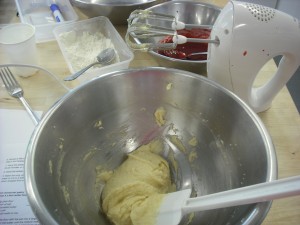
DSCF0011

The recipe of win was this delight from Bakerella and I’d recommend it to anyone who has previously considered themselves defeated by red velvet cake…

Gravlax with Dill & Gin

Gravlax is made with a dry cure: a mixture of salt, sugar and herbs which both preserve and flavour the fish.  Here’s a really easy, really quick little recipe that, if prepared in advance, will provide the basis of a luxurious minimum input/maximum yield mid-week dinner.

Ingredients

  • A side of salmon, halved, or 2 large skin-on salmon fillets
  • 100g Maldon sea salt flakes (or similar)
  • 100g demerara sugar
  • A handful of fresh chopped dill
  • 3 generous glugs of gin – quality is irrelevant.  I used deathly strong gin home-brewed by one of David’s colleagues but it didn’t make a blind bit of difference.  Gin is gin when you’re using this much salt!


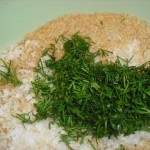
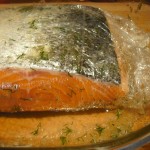
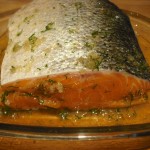
MixFish wrappedFish mix

Intructions

  • Pop the salmon in the freezer for at least two hours to kill off any unpleasant bugs then defrost it in the fridge.
  • In a bowl, mix together the salt, sugar, dill and gin.
  • Layer a third of the cure mix into the base of a flat-bottomed, non-metallic bowl.
  • Lay one piece of the salmon skin side down on this bed and scatter another third of cure mix over the top.
  • Place the second piece skin side up onto the first, press down firmly and cover with the remaining mixture.
  • Carefully wrap the fish tightly in cling film (leaving the ends of the package open to allow the juices to escape) and return to the flat-bottomed bowl.
  • Place a plate on top of the salmon and press down hard.  Then load the plate with as many heavy items as possible as the fish needs to be pressed whilst it cures.  I find that packs of butter and jars of jam do the trick.
  • Pop the whole lot in the fridge for three days and wait patiently.  After 72 hours the cure will have worked its magic and the dish will contain a good deal of liquid (a sort of concentrated brine).

Your flavourful dill & gin gravlax is now ready to eat.  Drain it, unwrap it and slice it very thinly.  This is perfect sprinkled with a little  lemon juice and served with crusty brown bread and butter.

Fish

The Company Shed

High up on my long list of things I love sits champagne and exploring.  Not far behind you’ll find the English seaside and all food associated with it.  Three years ago I discovered a place that combines all of these things.  That place is a wooden shack on the edge of an Essex salt marsh accessible only by a tidal causeway.

Sign

The Company Shed sits on the western edge of Mersea Island (1 ½ hours outside of London) and this fishmongers-cum-seafood eatery is one of my favourite date spots.  We’ve visited often to grab provisions for spring picnics but for the first time last weekend we braved the bleak landscape, frequent downpours and queues on the door to sit inside the shed itself and soak up its damp, salty, bustling atmosphere.

Oh, and eat the finest farmed flat oysters in the country.  And the crab.  And the prawns, peppered mackerel, smoked salmon, vinegary cockles, and crevettes.  Somehow the hot scallops with crispy bacon and the steaming mussels in cider also found their way on to our plates.  I genuinely have no idea how it happened, but we basically ate the sea.

We grabbed two plastic cups and a roll of kitchen towel from the shelf behind the fish counter and perched at our tiny table (stashing our champagne, salty butter and crusty bread brought from home on the floor).  Within moments the tide of seafood washed over our table and we had no choice but to dive right in.  And it was brilliant. Platter1

After an hour of munching, cracking and picking we’d amassed an impressive pile of shells of all shapes and colours and there was little more to be done than sit back and polish off the booze while failing to be subtle about eavesdropping on the conversations of other diners.

We settled up (our feast came in at £20 a head) and, before we left, invested £1 in two tubs of The Company Shed’s own fish stock to put to use in our own recipes at home.  There are so many great things about this place: the food; the price; and the atmosphere.  But best of all is the fact you can walk straight out of the door, onto the beach and immediately start walking off the inevitable food coma!

Beach

Straight from the sauce

My recent ‘Retro Puddings Workshop’ at Leiths School of Food and Wine was by no means ground-breaking in content. I can already whip up fairly respectable meringues, lemon curd and profiteroles and my pastry is improving with practice. Being back at cookery school was simply an excuse to mess around for five solid hours in an industrial kitchen, gossip with fellow foodies and enjoy the wonder of prepping in a space where all your equipment is stealthily taken away, washed-up and replaced by a wonderful team of kitchen ninjas.

In terms of recipes, the most useful ideas I came away with were for a selection of simple boozy sauces, toppings and fillings.

Limoncello Cream

For spooning over sweet trifles or citrus tarts

Ingredients

  • 120ml whipping cream
  • grated zest and juice of 1/2 a large lemon
  • 1 generous tablespoon Limoncello liqueur
  • 1 tablespoon of icing sugar – optional

Instructions

  • Dump all the ingredients except the icing sugar into a bowl and whisk together until well combined and the cream has thickened nicely
  • Taste
  • Decide whether or not to add the icing sugar for a bit of sweetness

Baileys Chocolate Ganache

For filling choux pastry when freshly made or rolling into truffles when left to set in the fridge

Ingredients

  • 170g double cream
  • 170g chocolate (75% cocoa solids or more), chopped
  • 3 tablespoons Baileys Irish Cream
  • 3 drops of vanilla extract

Instructions

  • Pour the cream into a small saucepan and heat through gently
  • All the cream comes to the boil, remove the pan from the heat and stir in the chocolate and Baileys
  • Stir until the chocolate melts
  • Thoroughly mix in the vanilla and then leave the mixture to cool completely (unless you want to use the ganache as an icing, rather than a filling, in which case, you will need to use the mixture while it is still warm enough to work with)

Chambord Raspberry Sauce

For drizzling on cheesecake or ice-cream or layering in a Vicky sponge or pouring over pancakes (basically this sauce is altogether quite brilliant!)

Ingredients

  • 220g raspberries
  • 3 tablespoons Chambord Liquer

Instructions

  • Pop the raspberries into a small saucepan and bring to the boil
  • Add the Chambord and boil to reduce to a thick puree
  • Push through a sieve and leave to cool

Cookery School

Savoury French Toast

Following my recent run of making sweet, Tartine-style French toast, a friend suggested adapting the recipe for a more savoury flavour. Rather than the usual sugar and vanilla based egg custard, we used a base of salt, pepper, fried garlic and oregano, and excellent, seed-filled slices of multigrain bread.

Sasha has written up our recipe on her blog, and provided a good step by step, pictured guide through the Tartine French toast method:

It did (of course) start with chopped garlic. Caramelized in butter and mixed into the egg/milk mixture my British friend insists on calling “custard.” A dash of salt, pepper, and oregano, and we’re pretty much set. (Although when I make savory french toast at home, I tend to use za’atar in the mix instead.)

Growing your own bread starter

When Ben visited us this christmas gave me a copy of the beautiful Tartine bread book. Since then i’ve been learning to grow my own yeast and making experimental sour dough with varying results. I’ve been growing my starter, dubbed Eric/B, for almost a month without killing him and produced 4 good loaves using the basic Tartine recipe. An off-cut of of Eric has even made his way to South London in the form Eric/B1, a gift to our our newest munchmun.ch contributor, Kriss.

I promised Kriss a post explaining how and when to feed his new friend, but if you’re not using an existing starter then you can make your own really easily. Just combine 100g flour mixture and 100g water follow the instructions for feeding the starter while omitting the kept start and add extra flour and water. Leave it a couple of extra days to get going before feeding, then continue as normal. This guide is a bit rough, but should be enough to get you going,

Tools of the trade

  1. A plastic tub to store the starter in. I’m using a supermarket humus-type pot.
  2. Kitchen cloth to go over the top of the pot, it might get messy. This helps avoid the mixture drying out too much/crusting on top
  3. Your flour mix, mine is 50% wholewheat, 50% white bread flour. Make a large batch of it up so you don’t need to mix it each time.
  4. Electric scales. You can use regular scales will do, but precision of digital and the easy of reseting to 0 make life much easier (I recommend these)

First question, what time to feed? I’ve been following the Tartine suggestion of doing it in the morning, but it seems theres no hard or fast rules. Find a time that works for you and stick with it, the most important thing is a consistant time. You’re “training” the yeast to rise and fall in cycle in preparation of using it to bake with.

Next, how does feeding work? The short version; remove 80% of the starter and replace the flour/water. This prevents the culture becoming too sour and vinegary while still developing the culture for baking with.

Take your existing yeast culture and clean off any dried bits round the top of the pot, or peel of any heavy crust that may have formed. Give the remaining mixture a good stir to get an even consistency, then remove all but 40g and reset your scales. Add 75g of your flour mixture and 75g of water and mix carefully. If you have a small pot then this will probably make a bit of a mess.

Pop the cloth over the top of the pot and put it somewhere with a reasonably warm consistant temperature. You can then decide how long you want to wait till feeding it again. Personally i’m feeding Eric once every 2 days, rather than the once a day I was doing, as i’m not actively baking at the moment and he was a lot of time/flour to feed everyday.

What if you miss a feeding? Don’t worry too much, it’s better to wait until the next planned feeding rather than feed out of your cycle. Your starter should be pretty resilient

I’ll be posting some recipes/pictures from my recent sough dough experiments soon, so once you have your own stable Eric you can bake with him. I just need to get the knack of it myself first, before I try and teach.

Beef en daube

I’ve been a self-confessed foodie for years now, and after several suggestions from the usual authors in the past I’ve finally managed to find my way here. I hope that I can provide some interesting recipes and culinary adventures for your general cogitation.

Wanting to branch out from my usual beef stew favourite of Carbonnade à la flamande I found a recipe by Allegra McEvedy that looked to be very much worth a try. It was followed pretty much faithfully and produced incredible results, but in future I will probably stick to making it in my cast iron dutch oven instead of a roasting tin.

Beef en daube Ingredients

  • 1kg braising steak
  • 100g cubed pancetta
  • 1.5pts red wine
  • 1.5pts beef stock
  • 1 tin of beef consomme
  • 10 shallots
  • 5 carrots
  • A handful of flat leaf parsley
  • A small bunch of fresh thyme
  • 5 garlic cloves
  • 50g butter (optional)
  • 1bsp plain flour (optional)

Instructions

  • Heat a roasting pan on the hob with a good glug of olive oil
  • Add the pancetta and thyme to the pan and turn down to medium heat
  • Peel the garlic and shallots, leaving both whole, and add to the pan and sweat for 10-15 minutes until the shallots are going soft and translucent
  • Pour in the red wine and scrape the crispy bits from the bottom of the pan, then simmer for 5 minutes
  • Cut the braising steak into cubes, season, and add to the pan on top of the shallots
  • Pour the beef stock and beef consomme over the beef and bring up to a simmer
  • Peel the carrots, cut them into big pieces and add to the pan
  • Cover the pan with foil and place into a preheated 170° oven for 2-3 hours or until the beef is tender
  • (optional) If you want the sauce to be thicker, drain it off into a separate saucepan, whisk the butter and flour together to make a beurre manié, and whisk into the sauce. It thickens quickly, so add it gradually until you get the desired effect!

I served this up with a a big pillow of buttery mashed potatoes and found it deliciously rich, with a deep flavour to the beef from all the red wine it’d sucked up. Definitely a meal that I’ll be adding to my list of regulars for times when it is particularly cold and windy outside.

Brownies

Brownies – and the content thereof - is a subject of much ongoing debate.  A friend on Twitter recently asked for a good recipe and received a number of wildly differing recommendations.  Some people vehemently argue the case for the use of 75% cocoa solids chocolate, others fight the corner for the addition of fruit or marshmallow.  Hell, there are even some weirdoes out there who really push the brownie boundary with an apple-based variety.  Madness.

This is all very well and good but, in my view, there’s nothing comparable to that bitter feeling of disappointment when you realise that the warm chocolate brownie with hot fudge sauce on the pudding menu is not a squidgy, gooey-bellied delight but a false promise of chocolate goodness containing dangerous little nut grenades.  Let’s get this straight people, WHOLE OR CHOPPED NUTS HAVE NO PLACE IN A BROWNIE.  There, I’ve said it.  I will not hear any arguments to the contrary.

Here is my nice, safe, NO VISIBLE NUTS, recipe for a decent brownie…

Ingredients

  • 225g dark chocolate (85% cocoa solids is best)
  • 225g unsalted butter, cut into cubes
  • 100g caster sugar
  • 3 tsp Vanilla essence
  • 3 eggs, beaten
  • 150g fine ground almonds (this is a perfectly acceptable form of nuts, they are ground to within an inch of their lives.  These are stealth nuts.)

Instructions

  • Preheat the oven to 170°C and line a square tin with baking paper
  • Melt the chocolate and butter together in a saucepan
  • Remove from the heat and tip in the sugar
  • Stir mixture well and add in the vanilla
  • Using a hand whisk (not an electric one), whisk in the beaten eggs
  • Continue to whisk the mix for a further two minutes or so until the ingredients are well combined and the mixture is completely smooth
  • Stir in the ground almonds
  • Pour the mix into the baking tin and cook for 25-30 minutes.

When you remove your brownie from the oven the top should be crispy and cracked.  When you cut into it (you’ll get about 12 generous squares out of this recipe) the middle should be dense, squishy and free from threatening little nuts.  Hah!

Knockout Lemon Tart

Regular readers of this blog will realise that while I love cooking in general, creating puddings, sweets and bakes is what really gives me my culinary kicks. 

Almost a year since my first visit, I’ll soon be heading back to Leith’s School of Food and Wine.  This time it’s courtesy of my best friend (and devout worshipper of the sacred cinnamon swirl), Fiona.  She’s decided that the one thing I need to improve my life, and presumably hers, is the ability to construct a perfect Sicilian lemon meringue sundae.  As such, I am being sent on a ‘Retro puddings workshop’ and shall return laden with treats.

In the meantime, here is a recipe for you that I didn’t have to go to school to learn.  I often used to boldly state that “I don’t do pastry”.  That was until just over a month ago when I decided that, having been given the task of cooking dessert for ten on Christmas day, I should face my pastry demons.  As an alternative to the sticky, heavy, boozy Christmas pud produced by my mother I thought I’d try my hand at some zesty lemon tarts.  Lo and behold, they did not burn, they did not flop and they did not fall apart!  Such was my joy at this, I am sharing my recipe* so that you too might feel like the cook you’ve always wanted to be…TartPastry

Ingredients

  • 255g unsalted butter
  • 200g caster sugar
  • 1/4 tsp salt
  • 2 eggs
  • 500g plain flour

Instructions

  • In a large bowl combine the butter, sugar and salt by mixing until smooth (I use a hand-mixer)
  • Mix in one of the eggs until smooth and then do the same with the other
  • Add the flour all at once and then mix on a low speed until incorporated
  • Tip the mixture on to a lightly floured work surface and divide into four and shape into a disk about 2cm thick
  • Wrap the disks in clingfilm and chill for two hours
  • Roll out pastry (do this quickly and avoid touching the dough too much) to the thickness you want – but no more than 1/2cm – and cut to fit your tart tin (you’ll get about 12 individual tartlets from this recipe or 4 nine-inch tart shells)
  • Press pastry into the tin, trim with a sharp knife and pop into the fridge for a final ten minute chill
  • Cook for a maximum of 10 minutes in a 190 degree but keep an eye out and remove them when golden brown in colour
  • Cool them on a wire rack and get on with making the filling

Lemon cream filling

Ingredients

  • 155ml lemon juice
  • 3 eggs & 1 egg yolk
  • 170g caster sugar
  • A pinch of salt
  • 225g unsalted butter

Instructions

  • Set up a bain marie on the hob
  • Combine the lemon juice, whole eggs, egg yolk, sugar and salt in a bowl
  • Place the bowl over the boiling water a whisk the ingredients together immediately
  • Keep whisking for 10 minutes or so (sorry, this takes some elbow grease) until the mixture becomes very thick
  • Remove the mixture from the heat and leave to cool slightly (about 60 degrees – ie still hot-ish – should do it)
  • While the mixture is cooling cut the butter into one-inch cubes
  • Using an electric whisk, mix the each cube of butter fully in to the warm mixture and then add the next, once all the butter is gone give the mixture one last thirty second blast with the whisk and you should be left with a thick, pale and glossy cream

Pour the lemon filling into your tart base, smooth out and leave to set in a fridge for at least 15 minutes.  All that’s left to do now is try not to look too smug when everyone exclaims how amazing it tastes.

*based on a version that appears in this cookbook

Roast Potatoes and Red Wine Vinegar

This evening I continued a new trend for hosting a small number of my friends for a medium-sized dinner party. Is ‘twice’ a trend? Perhaps. Last week was curry (that is, Indian food via Britain) and this week was a roast chicken dinner. There’s quite a lot to write about both, and the absence of a write up of the former means I’m going to post a very short thing about the latter, with more pending.

The roast potatoes accompanying the meal were derived from this recipe by Gary at Roast Potato. Everything about that preparation worked pretty well for me (and I should emphasize his point about cooking the potatoes beyond parboiled so that they flake at the edges.) Particularly effective though was one final touch: Near the end of cooking, once potatoes have started to crisp, add a dash of red wine vinegar. Tasted brilliant.